Predicting the outer heliosphere
Beyond the last day of available spacecraft data, MSWIM2D continues forward as a persistence forecast. Because the solar wind requires months to traverse the outer heliosphere, this forecast retains predictive skill at large heliocentric distances long after it has expired near Earth.
What the prediction is
The model run is a single continuous simulation. Up to the present it is driven by spacecraft measurements at the inner boundary (1 AU). Beyond the last hour of available data (the data frontier), no further measurements are available to constrain the boundary, so the model applies a corotation-persistence assumption: the most recent solar rotation (~27 days) of measured solar wind is repeated forward for one year. As the Sun rotates, the same longitudinal stream structure is assumed to recur at the boundary. The simulation then propagates this repeating boundary condition outward using the same physics applied to measured data.
Why it works
Solar wind launched from the Sun today does not reach Jupiter for weeks, or Pluto for months. Consequently, even though the boundary condition beyond the frontier is an assumption rather than a measurement, conditions at large distances remain governed by solar wind that left the Sun before the frontier, that is, by measured data. The forecast at radius R therefore remains accurate until the assumed boundary has had time to propagate out to R. This transit time increases linearly with distance, and so does the useful lifetime of the forecast.
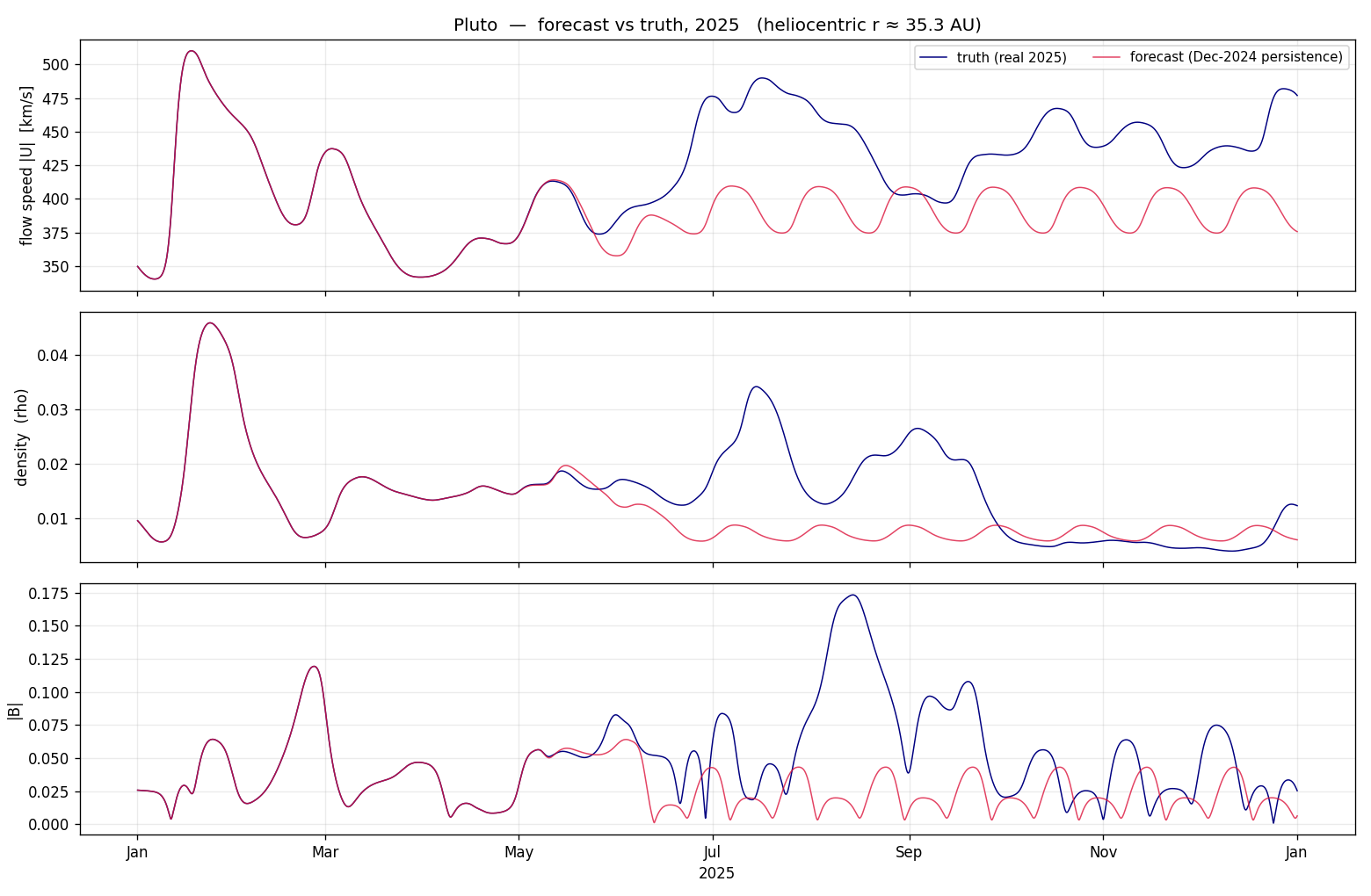
This can be tested directly by hindcasting: the data frontier is set to the end of 2024, the persistence forecast is run through 2025, and the result is compared to the fully data-driven 2025 run. Below, at Pluto's distance (≈ 35 AU), the forecast (red) tracks the data-driven result (blue) closely for approximately the first five months, until the repeated boundary condition reaches that distance and the two curves diverge.
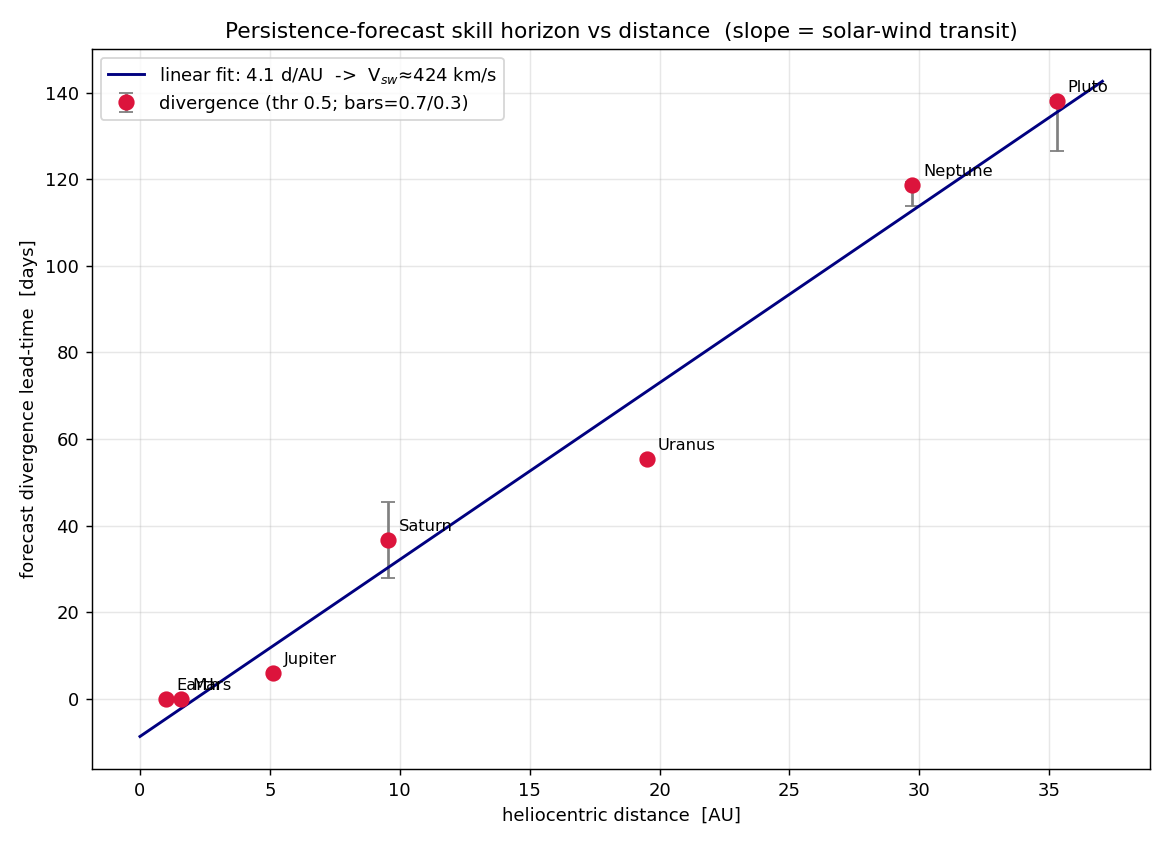
Repeating this procedure for every body yields the forecast's skill horizon (the duration over which it remains accurate) as a function of distance. The relationship is linear: approximately 4.1 days of skill per AU. Near Earth the forecast provides essentially zero useful lead time; at Pluto it remains accurate for roughly 140 days. The slope corresponds to the solar-wind transit time, equivalent to a bulk speed of ~424 km/s, consistent with typical solar-wind conditions.
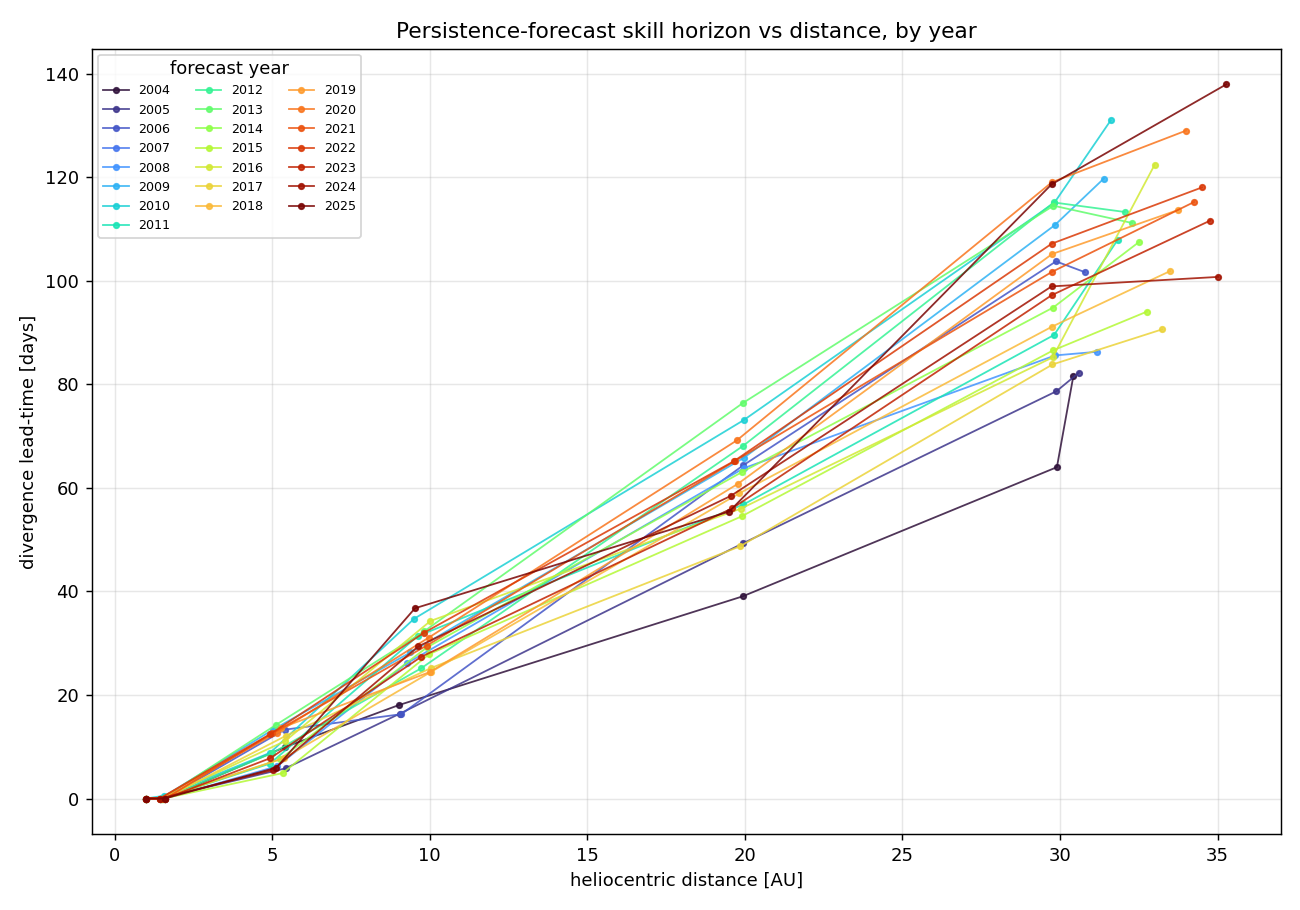
This result is not specific to a single year. Repeating the analysis for every forecast year from 2004 through 2025, spanning a full solar cycle, yields a consistent linear relationship throughout.
How to read the forecast
The forecast is most reliable at large distances and at short lead times. Apply it within the skill horizon for each body (~4 days per AU). Beyond that horizon, the curves represent the persistence assumption rather than a data-constrained prediction.
It is single-source. At the current data frontier, only the L1 (near-Earth) monitor is reporting, so the repeated boundary represents a single longitude corotated around the Sun, the standard heliospheric persistence forecast, rather than a multi-spacecraft reconstruction.
It advances with new data. As new measurements arrive, the data frontier advances, the forecast window shifts accordingly, and forecasted months are progressively replaced by data-driven results.